post any job for free and get it done at a cheap rate, advertise your business,skills and services, global tech and business news, get informed & ghet busy !!!
On Tuesday, the once-dominant cellphone manufacturer delivered its thinnest BlackBerry device to date, the DTEK50.
The name is significant, since DTEK also applies to the BlackBerry's
security watchdog software that we first encountered on the admirable,
but too-expensive Priv.
The 7.4-millimeter, 5.2-inch, Android-based DTEK50 is, accoridng to
BlackBerry, built for security. It offers full-data encryption, built-in
malware protection, hardware support for tracking and provisioning
(which should make the DTEK50 attractive for businesses), the DTEK
security app and additional "hardening" of the Android OS
Unlike the Priv, which has
a physical QWERTY keyboard hidden behind its large touchscreen, the
DTREK50 is touch only. On the software side, BlackBerry does provide a
smart, learning keyboard that will offer suggestions as you type. Like
other BlackBerry devices, the DTEK50 also comes with BlackBerry Hub
communications consolidation software.
The device also includes a 13 MP camera, dual LED flashes and expandable memory (up to 2 TB via a micro SD card slot).
Some have noted the DTEK50's resemblance to the new Alcatel Idol 4S
(right down to the thickness — 7.4 mm — and the unusual button on the
side, which BlackBerry calls a customizable Convenience Key). BlackBerry
did confirm to Mashable that it did not manufacturer the phone. The company did not reveal, however, if the DTEK50 was made by Alcatel.
What may excite BlackBerry fans (those who remain) the most, though,
is the price. The DTEK50 is on sale for preorder right now, starting at
$299 (the Priv started at $699).
Coworkers. Can't live with them, can't live without them. Some
coworkers make you feel so lucky to work with such incredible people day
in and day out. Others . . . not so much.
Having healthy
relationships with your coworkers isn't just critical for your career,
but for the company you work for as well. Clashing with an unruly
employee or supervisor at least once or twice in your career is
inevitable, but do you know the steps to take when your feathers get
ruffled?
Join us Wednesday, July 27 at 2 p.m. ET for our next #BizChats Twitter chat, where we’ll be discussing how to mend relationships with coworkers that simply just drive you crazy.
Joining us will be: Dr. Leah Klungness, Ph.D., psychologist and expert on relationship issues; Melanie Greenberg, Ph.D, psychologist, blogger and expert in cognitive-behavioral therapy for adults; Suzy Welch, business journalist, career advice contributor on the TODAY show and best-selling co-author of The Real Life MBA; Sylvia Lafair, Ph.D., business leadership expert in optimizing workplace relationships.
There's nothing that helps you cool down from a summer heat wave more than staying inside for a good ol' binge-watching session.
Netflix has a lot of new — and a lot of old — shows and movies coming
to its platform in August. Here's a look at what's landing (and
expiring) on the streaming service this month
Baz Luhrmann doing a TV show? Yes please. The drama, which centers
around the early hip-hop scene in 1970s New York, is basically the
musical TV show of our dreams.
Also coming to Netflix in August: TV Masha and the Bear, Season 2, Netflix original (8/1) NCIS, Season 13 (8/1) Roseanne Collection, Collection 3 (8/1) Beat Bugs, Season 1, Netflix original (8/3) David Cross: Making America Great Again, Netflix original special (8/5) Real Husbands of Hollywood, Season 4 (8/9) Ask the Storybots, Season 1, Netflix original (8/12) The Get Down, part 1, Netflix original (8/12) Project Mc², Season 2, Netflix original (8/12) Louis CK: Live at the Comedy Store (8/15) Puffin Rock, Season 2, Netflix original (8/17) Bottersnikes and Gumbles, Season 1, Netflix original (8/19) Fearless, Season 1, Netflix original (8/19) Maz Jobrani: I'm Not a Terrorist, But I've Played One on TV (8/21) Law & Order: Special Victims Unit: The Seventeenth Year (8/22) Dawn of the Croods, Season 2, Netflix original (8/26) Glitter Force, Season 2, Netflix original (8/26) Jeff Foxworthy and Larry the Cable Guy: We've Been Thinking, Netflix original comedy special (8/26) Once Upon a Time, Season 5 (8/26) Ku'damm 56, Season 1 (8/31) Movies The American Side (8/1) An Inconvenient Truth (8/1) APEX: The Story of the Hypercar (8/1) Beethoven's Christmas Adventure (8/1) Big Daddy (8/1) Black Widow (8/1) Critical Condition (8/1) Deadfall (8/1) Destination: Team USA (8/1) The Family Man (8/1) The Fast and the Furious (8/1) The Fast and the Furious: Tokyo Drift (8/1) Final Destination 3 (8/1) From the Terrace (8/1) Funny or Die Presents: Donald Trump's The Art of the Deal: The Movie, Netflix exclusive (8/1) The Naked Prey (8/1) Memoria (8/1) ISIS: Women Unveiled (8/1) In the Shadow of the Moon (8/1) How to Win the U.S. Presidency (8/1) Holding the Man, Netflix exclusive (8/1) Pay It Forward (8/1) The Real Texas Chainsaw Massacre (8/1) Sleepy Hollow (8/1) Star Trek: Nemesis (8/1) Sliding Doors (8/1) Young@Heart (8/1) What Women Want (8/1) The Wedding Planner (8/1) The Verdict (8/1) Teacher's Pet (8/1) Zack and Miri Make a Porno (8/1) Punk's Dead: SLC Punk 2 (8/5) Ever After High: Epic Winter, Netflix original (8/5) The Little Prince, Netflix original (8/5) The Confirmation (8/6) TRex (8/9) St. Vincent (8/10) Flight of the Butterflies (8/11) No Country for Old Men (8/11) 13 Cameras (8/13) Our Last Tango (8/16) Let's Go to Prison (8/16) The Last Heist (8/17) The Curse of Sleeping Beauty (8/17) I'll Sleep When I'm Dead, Netflix original (8/19) Septembers of Shiraz (8/23) The Road (8/25) Blue is the Warmest Color (8/26) XOXO, Netflix original (8/26) Rams (8/27) The State of Marriage (8/29)
Next time you're ordering your textbooks from Amazon, you can also order a student loan.
Amazon is entering the private student loan business through a partnership with Wells Fargo.
Wells Fargo's student lenders will offer a 0.5 percent interest rate
discount to members of Prime Student, Amazon's half-price version of
Prime for college students.
Amazon already offers small business loans through Amazon Lending,
the invitation-only loan program for third-party sellers it launched in
2012. But this will be the company's first involvement in the student
loan market.
The interest rate discount will be available for all Wells Fargo student loans, including both new loans and loan refinancing.
“We are focused on innovation and meeting our customers where they
are – and increasingly that is in the digital space,” John Rasmussen,
Wells Fargo’s head of Personal Lending Group, said in a press release. “This is a tremendous opportunity to bring together two great brands.”
As for Amazon, the company said in a statement, "Amazon has a track
record of investing in great offerings for students, starting with the
Amazon Prime Student program. We’re excited to extend this new offering
from Wells Fargo to our Prime Student members."
Private student loans are a booming industry, albeit one that has
faced criticism. For the 2014-2015 academic year, students and parents
borrowed $106.1 billion, 10 percent of which was nonfederal loans, according to the College Board. According to the Wall Street Journal,
the amount of money loaned to borrowers by the five biggest private
lenders between July 2015 and March 2016 grew 7 percent from the prior
year.
Wells Fargo is a distant second to the nation's largest private student loan lender, Sallie Mae.
Students who accept financial aid packages with predetermined federal
loans likely won't be tempted by Amazon's offer. But those already
looking to subsidize federal money with private loans, where interest
rates can depend on the borrower's credit score, could be intrigued by a
promised half-percent discount.
Those already borrowing from Wells Fargo, too, could be persuaded to sign up for Prime Student, which costs $49 a year.
Congrats! You're 23 years old and you have your first real job.
On the downside, you now work long hours, wear uncomfortable shoes
all day and can't take naps. Even worse, your paychecks get divided
pretty evenly between rent, food and student loan payments.
Understandably, you haven't bothered to start a retirement fund yet —
you're only 23! You have 39 years before you need to even start
worrying about retirement, right?
Wrong.
Dan Egan, director of behavioral finance and investments at Betterment, and Qapital
founder and CEO George Friedman discussed about why every young adult needs to be
planning their financial future — and why it's so difficult.
"The 20s are a crucial time to start building wealth and saving for
retirement," Egan said. "The younger you start investing, the more you
can reap the benefits of compounding and long-term market gains.
Additionally, at this age, you can afford to invest more aggressively
and take on a little more risk in order to earn better returns."
When asked how much a person should set aside, Egan said that it
varies by situation. However, he would give everyone the same advice.
"The simple answer: save more. If you aren’t able to contribute
substantial amounts of your salary yet, it’s most important to just get
in the game," he said. "Once you’re in a stable position in your life
and career, committing at least 20 percent of your annual income
(including retirement savings) to your investment portfolio is the way
to go."
It is hugely important for young people to be planning for their futures, but very few of them do. A survey from Scottrade found that 64 percent of millennials haven't even begun to think about retirement.
This graph from J.P. Morgan illustrates the earning potential your investments have.
A graph showing the earning potential of retirement investments
Image: J.p. Morgan asset management
It
shows that a 10-year delay in putting away money for retirement can be
impossible to make up. Chloe, who starts investing at age 25, will make
$950,588 more than Lyla, who had the exact same investment plan, but
started at age 35. Chloe only invested $100,000 more than Lyla.
Putting away money early in your career is obviously a sacrifice.
Every dollar being put in a retirement account is a dollar not being
used to buy the next round or to see that new band coming to town.
Those are sacrifices that are important now, so that you don't have to make tougher sacrifices when you get older.
"It might seem like a sacrifice to save 20 percent of your income
right now," he acknowledged. "But think about it this way: By saving as
much as you can while there are fewer demands on your income, you put
yourself ahead"
It's easy to tell young people to save, but it's not always possible.
According to a survey conducted by the National Association of Colleges and Employers, members of the class of 2016 are expected to have an average salary of $50,556. While that does sound like a lot of money, it goes fast once you're in the real world.
CEO George Friedman advised recent grads who don't know where to start
to put a system in place, regardless of how much they were able to set
aside.
"Start by focusing on getting into the right habit, you can up the
amounts later on. Really, just do it, even if you start with only $100 a
month," he said. "At Qapital, we see many first-time savers who
automate it for small amounts and before they know it, have significant
amounts stacked up for anything from a down payment for a house to a
summer festival ticket, or a first large chunk toward a retirement
fund."
We asked Friedman how much of a difference a few years will really make.
"A huge difference," he said. "That is because the money you put
aside at the start will have a really long time to grow, thanks to
compound interest. It’ll also hurt less if you go easy at the start and
start saving small, instead of trying to play catch-up with large
amounts later on."
Friedman also said that young workers shouldn't let loans or debt stop them from planning ahead.
"Waiting to save until you’re debt-free could be a long way away.
Just because you have loans to pay off, doesn't mean you can't make
smart financial choices for your future. The earlier you start saving
for retirement, the more time your money will have to grow. And, with
the right plan, you’ll pay off your debts along the way."
So, there you have it. Start saving now
While the average Chinese shopper is becoming more carefree when it’s
time to buy a new phone, China’s teens are counting their pennies a lot
more carefully.
Most Chinese teens have smartphones that cost up to $130. That’s in
contrast to adults, about 51 percent of whom have phones that cost from
$150 to $450, according to data released this week by local search
engine giant Baidu.
The result is bad news for Apple. Because of budget constraints for
most, the iPhone is the eighth most popular smartphone brand among the
nation’s teens – as opposed to the fourth most popular with everyone
else in China.
Youngsters in the US, meanwhile, are wild about their iPhones.
69 percent of American teens surveyed earlier this year by Piper
Jaffray said they’re iPhone owners – a figure that’s up from the year
prior.
Xiaomi hanging in there
Xiaomi, Huawei, Oppo, Samsung, and Vivo are the five most-used brands
of the mini-millennials. That’s some succor for Xiaomi at a time when
most of the country’s phone buyers are trading up to ever pricier
models. The average phone price in China rose to $319 last year, up from $260 in 2014, according to data from Canalys.
In its report, Baidu compares and contrasts China’s “post-00s”
generation – people aged up to 16 – with everyone else. The data is
mostly pulled from some of the 120 million active users of its Baidu
Mobile Assistant app, with some parts put together from a mobile survey
of 5,819 users.
Fewer apps
Here are a few more findings about China’s teens and their phones:
They use fewer apps than the average person. 70 percent of the teens have up to 30 apps, compared to 64.7 percent of everyone else.
They’re much more likely to be using the phone for streaming music, video, gaming, and snapping pics. And of course for studying. Adults are a lot more keen on social media, shopping, and news than the kids.
Gaming skews heavily to teen boys.
84 percent are on Android. Just six percent on iOS. There’s no data on the remaining 10 percent.
Girls more likely to be hooked on their phones, with 35 percent spending five hours or more per day on them – compared to 30 percent of the boys.
Adults, however, spend more time on their phones than the teens. Perhaps there’s too much homework to get done.
Converted from Chinese yuan. Rate: US$1 = RMB 6.68.
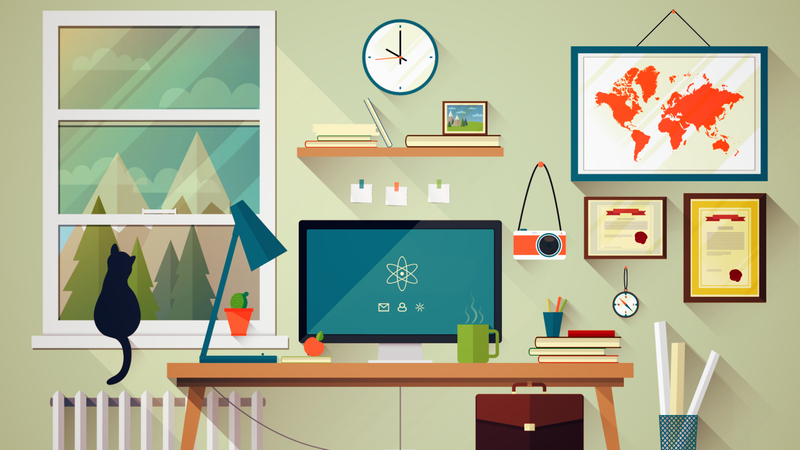
Few things affect our productivity as much as what we surround ourselves
with. Yet most of us rarely take the time to step back and really
analyze our working environment. Instead, we take a ‘set it and forget
it’ approach to where we work.
We
go to the same office, the same coffee shop, the same co-working space
and try to force ourselves into a productive flow. Because we spend so
much of our lives working, why not try to make the place we work the
best it possibly can be?
Whether you’re at home, in a shared space, or hanging out a coffee
shop there are quick and easy fixes to help make your work space work
for you.
Why Our Environment Matters (Even When We Don’t Notice)
You may think that you’ve got a good set up, but read into the ways
that our surroundings affect us on a subconscious level and you’ll start
to feel pretty uneasy about your environment.
Studies have shown how our working habits, both good and bad, are
often related to some sort of external trigger or cue, which researchers
are increasingly tying to our surroundings. We visit the same places, work at the same desk, and are constantly surrounded by the same influencing factors.
Which is great, right? Find a good working environment and you’ll be
forced into a state of flow. But unfortunately, like most things to do
with how our brains work, there’s so much more beneath the surface.
As we evolved, our subconscious brain has been trained to keep us
safe, even when we don’t realize it. When we’re under threat we need to
make decisions quickly, which our brain does through something called
‘thin slicing’. This means it takes one small element of reality and
generalizes it, and from that it will determine what behavior to adopt.
So those triggers and cues in your workspace aren’t just affecting
you in a way you can consciously comprehend, they’re changing the way
your subconscious brain thinks and acts.
Students holding a hot cup of coffee for a few seconds before
being asked to judge a hypothetical person, were more likely to describe
them as warmand friendly than those holding an iced coffee
People will behave more competitively if there’s a briefcase in sight—or even if there’s a picture of a briefcase on the wall. And this happens even when people have no conscious memory of having seen the briefcase afterwards.
If you talk to someone who consistently uses words like down, depressed, low, pointless, and disappointed you’re likely to feel the same way
Even the subtle aroma of cleaning liquid in the air causes people to be perceptibly cleaner and tidier than usual
So how do we create an environment that’s optimal for making us feel
the way we want to during the working day: motivated, productive, and
creative?
Kill the Clutter Before It Kills You
There is a long history of creatives and thinkers with cluttered desks. As Albert Einstein once so eloquently put it:
“If a cluttered desk signs a cluttered mind, of what, then, is an empty desk a sign?”
However, whether it’s your closet or office desk, excess things in
your surroundings can have a negative impact on your ability to focus
and process information.
That’s exactly what neuroscientists at Princeton University found
when they looked at people’s task performance in an organized versus
disorganized environment. The results of the study showed that physical
clutter in your surroundings competes for your attention, resulting in
decreased performance and increased stress.
A team of UCLA researchers recently observed
32 Los Angeles families and found that all of the mothers’ stress
hormones spiked during the time they spent dealing with their
belongings.
Similar to what multitasking does to your brain, physical clutter overloads your senses, making you feel stressed, and impairs your ability to think creatively.
However, it’s not as easy as just getting rid of the excess things in
your life. We don’t create clutter simply through laziness or being
unorganized, it literally hurts your brain to give them up. Researchers
at Yale recently identified that two areas in your brain associated with pain, the anterior cingulate cortex and insula,
light up with activity in response to letting go of items you own and
feel a connection towards. This is the same area of the brain that
lights up when you feel physical pain from a paper cut or drinking
coffee that’s too hot. Your brain views the loss of one of your valued possessions the same as something that causes you physical pain.
So what do we do to reduce the stress of clutter?
Apply constraints: Whether it’s Twitter
followers, tabs open in your browser, notebooks, or magazines, setting
hard limitations and sticking to them is the best way to stop
accumulating more.
Use small storage spaces:Parkinson’s Law says we fill the time we have available to us, and the same could be said about clutter. Less room means less room for clutter.
Conduct a monthly review of your space: Set time aside to clean, sort, and discard every single month.
There’s a reason we feel inspired by large spaces or refreshed from
sitting by the window. Apart from a heavy dose of Vitamin D,
architecture can have a huge impact on our productivity.
Author James Clear gives the example of researcher Jonas Salk,
who, after spending years trying to discover the cure for the polio
epidemic ravaging the US in the 50s, travelled to the quiet hills of
central Italy where he stayed at a 13th-century Franciscan monastery
known as the Basilica of San Francesco d’Assisi.
The space changed the way he thought:
“The spirituality of the architecture there was so
inspiring that I was able to do intuitive thinking far beyond any I had
done in the past. Under the influence of that historic place I
intuitively designed the research that I felt would result in a vaccine
for polio. I returned to my laboratory in Pittsburgh to validate my
concepts and found that they were correct.”
Jonas’ example is just one of many.
It’s been long known that schools with more natural light provide a
better learning environment for students and test scores often go up as a
result. And natural light and fresh air are known to stimulate
productivity in the workplace as well.
You might not be in a position to choose your workspace, but there
are quick fixes: look for a spot with natural light from a window or
skylight, take a walk outside when you feel stuck, or simply explore a
new location.
A new environment can quite literally lead to new ideas. And what’s even more exciting is that studies have shown it’s actually easier to build new habits in new places.
Use Different Places for Different Places of Mind
We know that different locations will affect us, so why not use that
to our advantage? Our brains love habits, and if we can associate
certain qualities with different places, it can help us get into a
better working flow. This is called ‘task association’, where your brain
knows that when you’re in a certain place, you’re taking a certain
action.
Writer Gregory Ciotti gives one great example of how he forces himself into a better working flow just by changing the device he’s using.
In his example, he’s trained his brain to know that when he’s at his
desktop it’s time for deep writing like articles. The laptop is for more
shallow work like emails or informal posts. And lastly, the tablet is
for reading only.
This technique is so powerful it’s even been used to help treat people with insomnia
by telling them to only go into their bedroom if they’re actually
tired. If sleep isn’t achieved in a reasonable amount of time, they were
instructed to leave and move onto another task until they were tired
again.
If you can set up multiple workspaces for different tasks you’ll also
be able to force your mind into a certain flow, just by physically
being somewhere.
A great example of this is writer and artist Austin Kleon who keeps two desks setup in his space:
an ‘analog’ desk filled with paper, pens, and markers; and a ‘digital’
desk with laptop and tablet. Idea creation and ‘playing’ takes place on
only the analog desk, while shaping, editing, and publishing is in the
digital domain.
Set Yourself Up for Success
We may think we have the willpower and control to push through harder
tasks, but deep down we’re all lazy. But it’s not entirely our fault.
Our brains have been taught to conserve energy at all costs and make
subconscious decisions for us based entirely on how hard or easy it is.
So if you want to create a workspace that’s productive, focus on making
it easier to do the things you want to do, and harder to do the tasks
you don’t.
Stanford professor and psychologist BJ Fogg calls this ‘designing for laziness’.
Sometimes it’s as easy as turning your phone off and putting it in a
drawer so every time you’re tempted to check it you have to go through a
lengthy process, while other times it might mean unplugging your TV and
putting it in the closet.
One technique I’ve used lately is to close all of my tabs in my
browser at the end of the day (a hellish chore for any writer), leaving
only my most important task open. The next day, the easiest choice is
just to keep working on whatever was left from the day before.
I’m certainly not the first person to use this technique. Even
Hemingway used to stop writing mid-sentence so that he always knew where
to pick up the next day.
Curate Your Senses
Beyond the physical layout and mental associations of your space,
there are some auxiliary things you can also control. The sounds around
you and the music you listen to can have a huge impact on your
productivity.
We’ve written about the power of music and how to find the right track for the right task
before, but it’s important to note that certain sounds can be
incredibly harmful to how you work. Studies show that of all things, intermittent speech—hearing small snippets of conversation—can have an incredibly negative impact on your ability to concentrate. One meta-analysis
examined 242 studies of the ways noise affects performance, and found
that when it came to performing cognitive tasks—like staying attentive,
reading and processing text, and working with numbers—performance was
more affected by intermittent speech than by either continuous speech
(which would have little variation in volume and rhythm) or non-speech
noise. Bad news for those of us in shared spaces or offices.
There are options though. If you can’t find a spot that’s silent,
noise cancelling headphones or music that drowns out speech can help
regain that focus.
When it comes to nature versus nurture in how we work, nurture almost
always come out on top. The habits we’ve formed and the triggers we
surround ourselves with can have a huge impact on the quality of work we
do and how much we get done in a day.
But with a bit of mindfulness and tweaking we can create the kind of space that helps us get into flow quickly and more often.